The Wider Screen: Dogme 95 – Reinventing the Film Wheel and The Idiots

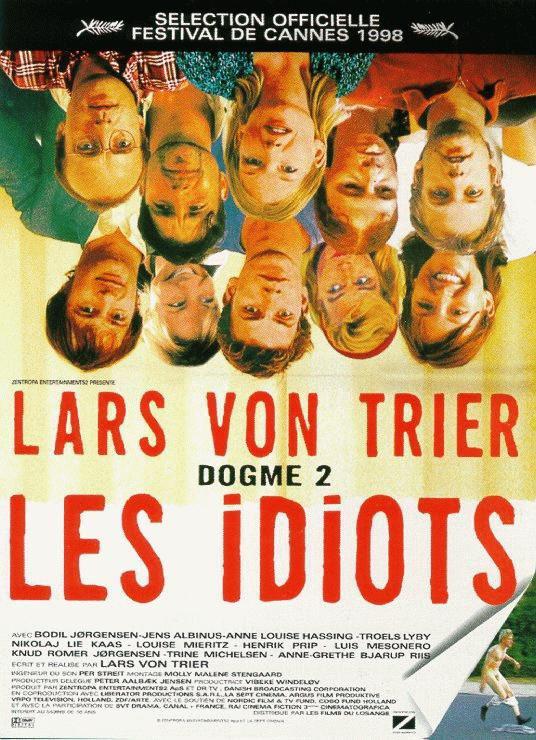
The Idiots (1998, von Trier)

Dogme 95 was an avant-garde movement of film created in 1995 by Danish directors Lars von Trier and Thomas Vinterberg. The directors believed that cinema had fallen into overly aesthetic and thematically vapid cinematic decadence and proposed an alternative in an attempt to revisit a time in film history before contemporary trends had overtaken filmmaking. After discussing how they wished to pursue this new ideology, they created the Dogme 95 manifesto and its Vows of Chastity.

The Idiots (1998, von Trier) was among the earliest films made within the Dogme 95 movement, telling the story of a group of young men and women with anti-bourgeoisie ideals who pretend to have mental disabilities in an effort to both disturb and reject the society in which they live. The film makes full use of explicit and disturbing imagery, ranging from emotionally raw scenes such as when one of the group is taken away to an explicitly shot orgy scene.

In many ways, The Idiots is representative of the Dogme 95 movement as a whole. As Walters describes “[…]precisely because of its many imperfections and discomforting subject matter, The Idiots may be the most fully developed and compelling expression of Dogme ideology. The meaningfully artless form and content of The Idiots are intertwined in particularly unique and revolutionary ways, enabling the film to critique contemporary film and contemporary culture.” (Walters, Tim. Reconsidering The Idiots: Dogme 95, Lars von Trier and the Cinema of Subversion?). The term “meaningfully artless” is particularly interesting. In many ways, the use of its low budget and almost amateurish style in some ways enhance certain aspects of the film. A scene that exemplifies this is the scene in which one of the group is forcibly taken away from the group, and the protagonists desperately attempt to prevent this, only to fail. Due to the lower grade of film, the handheld style (even seeing the camera operator’s shadow) and the distinct lack of music, it creates a pseudo-documentary style and equally draws the viewer in as much as it alienates them. It creates the illusion that this is painfully and uncomfortably real, something that the ‘decadent’ mainstream would potentially fail to achieve.

The aftermath of losing one of the members

The characters “spassing” can be read as a representation of von Trier’s frustrations with mainstream contemporary cinema. The society that they are attempting to provoke fits within a very strict set of rules that care more for the aesthetic than the content itself, while the characters reject this notion and act out in these ways as a form of protest, as well as “to take the piss”, much like the foundation of Dogme 95 itself. The film culminates in the aforementioned orgy scene, in which the characters remove their self-imposed restrictions and have sex while “spassing”. This act of pure unreserved and unstructured expression can be read as a “[…]self-reflexive allusion to the technical prescriptions of the “vow of chastity” that each Dogme film must adhere to, forging a critical connection between the transformative power of unmastering oneself both as a director and with regard to the practices of everyday life.” (Walters, Tim. Reconsidering The Idiots: Dogme 95, Lars von Trier and the Cinema of Subversion?) While uncomfortable, the sheer power of this scene is tangible and is an example of the potential of something such as Dogme 95’s rejection of standard film language, but instead puts the events and human struggle above all, as well as the potential for films over all.

Dogme 95 ended in the early 2000’s, ironically due to von Trier and Vinterberg believing that is was becoming too mainstream. While the movement was short, to consider it a failure is perhaps not giving it the credit it deserves. It not only is a glimpse to the power of film, the potential of any those with an idea and a camera, but pushes the boundaries and structures that we allow ourselves to be contained within. This meaningfully artless movement ended how it began, challenging the norm and on its own terms.

Works Cited and Further Reading:

Walters, Tim. Reconsidering The Idiots: Dogme 95, Lars von Trier and the Cinema of Subversion?

The Idiots

Behind The Rules Of Dogme 95

https://www.theguardian.com/film/2012/nov/25/how-dogme-built-denmark
The Wider Screen: Czech New Wave Cinema – Escaping the Oppressive Rabbit Hole

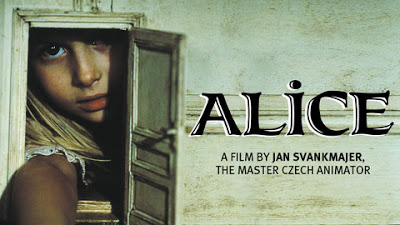
1988, Jan Svankmajer

During its early life, Czech cinema was strong and stable, for the time period. Beginning comparatively later than their foreign counterparts in France and Britain, their cinematic form began in the 1920’s and movements such as the Devětsil, an avant-garde Czech group that, from 1923 onwards, focused on the idea of Poetism. They preferred to explore the proletarian struggle, finding art, beauty and intrigue in the everyday, with one of its most prominent members, Karol Teige, remarking that “The most beautiful paintings in existence today are the ones which were not painted by anyone.” (Karel, Srp (May 1999). Karel Teige in the Twenties: The Moment of Sweet Ejaculation). However, this unfortunately was not to last, for in the mid-20th century, the country was successfully occupied by the Nazi party during World War II and their culture was assimilated and dominated by this invading force. Their cinema was suppressed and largely used for propaganda purposes, if allowed at all, which forced more free thinking films to go underground during this period. After the war, there was a period of time that has been referred to as the Golden Age of Czechoslovakian Films that lasted throughout the 1960’s, but this too was curtailed by the invasion of the Soviets in 1968, forcing them into a communistic society. This oppression strained and narrowed artistic output for filmmakers, but several still attempted to express their thoughts and opinions through subtler means, such as using absurdist, metaphoric and darkly humorous stories. In this regard, one cannot separate the climate of the country from its film output.

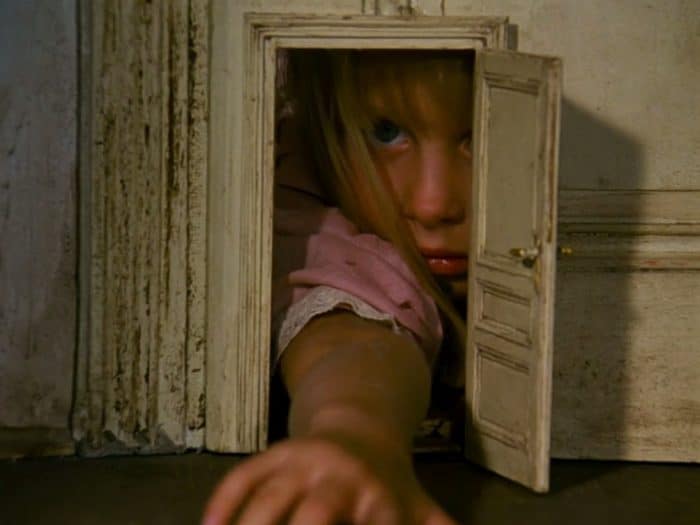
Jan Svankmajer was one such filmmaker during this communist period, who had previously been banned for the better part of a decade due to controversial filmmaking exploring the truth behind Czech life. His most famous work is Alice (1988, Svankmajer), a film that exemplifies that notion. The film acted as a subtle form of protest against the oppressive society in which it was made.

Within the film, Alice follows the White Rabbit, who is dressed as a nobleman and works closely with the King and Queen of Hearts. The character of Alice, representative of the Czech people, is constantly chasing after the rabbit, chasing after his status, but is constantly blocked by literal locked doors that she must figure out how to pass. Due to the enforced ideologies of the communist Soviets, social mobility was all but impossible, with the only way to move up from your position was often through underhanded and atypical methods, meanwhile those in the upper class had the doors opened for them, visually expressed as the rabbit having a literal key to move from room to room.

Alice is blocked from advancing in her quest to catch the rabbit.

The film also expresses a dour view of this said ruling class. Later, during the trial, Alice is given a script to read from, confessing to crimes she hasn’t committed. This is not only reminiscent of forced confessions that were commonplace during this time, but also of the censorship of the filmmakers, and Jan Svankmajer himself. They were told what to say and in what way to appease the ruling class, and any sense of autonomy was dismissed. This is further represented that the court are all puppets and cutouts, none of them having true human qualities, but only facsimiles of them, and acting as puppets for the larger controlling entity that was the communist ideology. Svankmajer even has the Queen of Hearts continually skipping to the end, creating a sense of dark inevitability that the individual is doomed regardless of if they abide by or ignore the rules.

In the end, both Alice and Czech New Wave are a dark and surreal response to the socio-political climate their country were in at the time of their creation, an attempt to rage against the seemingly all-encompassing power that were their oppressors, and a reflection of the cultural consciousness being expressed in the most extreme and shocking ways.

Works Cited:

Karel, Srp (May 1999). Karel Teige in the Twenties: The Moment of Sweet Ejaculation

The Wider Screen: British Horror Cinema – The Rise and Fall of Hammer Horror

“The World’s Greatest Horrorama!”

The horror genre has always been dealt a fickle hand. Since the early days of cinema, horror has been looked upon as a novelty at best, and an undesirable and uninspired genre at worst. From the early days of cinema, filmmakers realised the potential to shock and awe their audience. The creation of trick films was an early example of this, but rarely was used to frighten. While for a time the genre of filmmaking was popular in its campy and often Victorian melodramatic ways, with the forerunners such as Universal Horror and Tod Slaughter being the most notable with their classic films such as Frankenstein (1931, Whale) and Sweeney Todd: The Demon Barber of Fleet Street (1936, King), respectively, this would eventually die down due to World War II. Post-war, the void created was filled by a company that would become a genre defining and iconic force in the industry.

Hammer Horror was created by filmmakers James Enrique Carreras and William Hinds in the 1930’s, but it wouldn’t be until the 1950’s that they would begin producing films that would make them the known studio they are today. The most notable of these was The Quatermass Xperiment (1955, Guest), a story of an astronaut that has started to mutate after a space mission gone wrong. The film was a huge success, with the horror aspect appealing to audiences more so than the science fiction elements, and thus allowing the company to capitalise on the success (creating more Quatermass films, and The Curse of Frankenstein (1957, Fisher). This came at the perfect time, as their license with their distributor had run out and the invention of television was becoming a major and powerful rival. With this success, Hammer now had an audience and a direction, with Michael Carreras even stating “The film that must take all the credit for the whole Hammer series of horror films was really The Quatermass Xperiment” (Meikle, Denis (2009). A History of Horrors: The rise and fall of the house of Hammer). The release of The Curse of Frankenstein proved an even bigger success than Quatermass, earning 70 times its budget in box office revenue. It made use of (then) new actors Peter Cushing and Christopher Lee as Frankenstein and the Creature, respectively, and the new ability to create feature length films in colour. All this would lead to their new domination in the genre.

But what made their films to be continually popular is slightly deeper. As Peter Hutchings theorises, the Hammer Horror film played into society’s social and political zeitgeist of the time. The Second World War had shook Britain to its core, and culture was beginning to radically shift as they were nearing the 1960’s. In this way, the films played into the increasingly old fashioned and conservative beliefs of traditional storytelling (with the concept of the masculine and learned expert coming in to save the working class from a mysterious “Other”), while hiding behind a dark and thrilling aesthetic that appealed to the younger audience. This is clear in Dracula (1958, Fisher), exemplified in the final confrontation, with the titular character fulfilling the Other role, and van Helsing playing into the Expert role, while saving the townspeople and damsel. The two are both upper class, learned and masculine in similar but differing ways, and ultimately clash both physically and mentally, with the learned Peter Cushing winning out by outwitting his foe. These conservative views reassured the public, feeding into the wish to be saved by those in power, the ‘Experts’ from far away. Hutchins describes it as “[…] these horror films do draw upon, represent and are always locatable to much broader shifts and tendencies of British social history. […] when we look at the films themselves [we need] to be aware of how they fit into […] the characteristic practices of and concerns of British cinema at the time of their production.” (Hutchins, Hammer and Beyond: The British Horror Film, 1993).

However, this success would ultimately not last. As the audiences and society moved on, the Hammer Horror became increasingly stale and could hardly compete with their competitor’s oversees. As The Wicker Man (1973, Hardy) was released, America saw the release of The Exorcist ( 1973, Friedkin). The cinematic landscape had changed, with cinematic phenomenon such as Jaws (1975, Spielberg), Star Wars (1977, Lucas) and The Shining (1980, Kubrick) on their way in just a few years. The sensibilities of Britain had changed, but Hammer had failed to change with them. Despite this, the studio’s legacy is still felt to this day, and like their undead monsters, may rise again one day to terrorise cinema once again.

Works Cited:

Meikle, Denis (2009). A History of Horrors: The rise and fall of the house of Hammer

Hutchins, Peter (1993). Hammer and Beyond: The British Horror Film

The Wider Screen: Korean Cinema – Inspiration From Domination

By Park Chan-wook

Korea’s history has been as swift as it has been turbulent. This has been no less true during the 20th century. The Japanese occupation affected all parts of Korean culture and industry, from their language, names and, naturally, their media output. Under the Japanese rule and their regulations, the country’s film output was heavily monitored and censored, with many films being outright destroyed for being deemed ‘inappropriate’ by the authorities. However, after World War II and the subsequent crippling of Japan’s reach, Korea found itself largely liberated as it entered into the 1950’s, and along with this, so was their cinema. This new era of cinema, or New Korean Cinema, would go on to push the boundaries of cinema storytelling and explore the nuances of the previous hegemony that they now found themselves free of. This is something Paquet would describe as “The story of what happened when filmmakers finally escaped their confinement and became free.” (Paquet, 2003), while Min describes the Korean cinema as incorporating “haan“, describing it as “[…]the result of injustices from, among others, parents, […], an occupying army, a past government […] an unfulfilled wish or longing […] Haan has been a central theme in Koreans arts including films“, indicating an interest in exploring these “injustices” thematically. Director Bong Joon-ho describes that due to their history, they naturally like spicy” cinema and using the chaos around them as a source of inspiration.

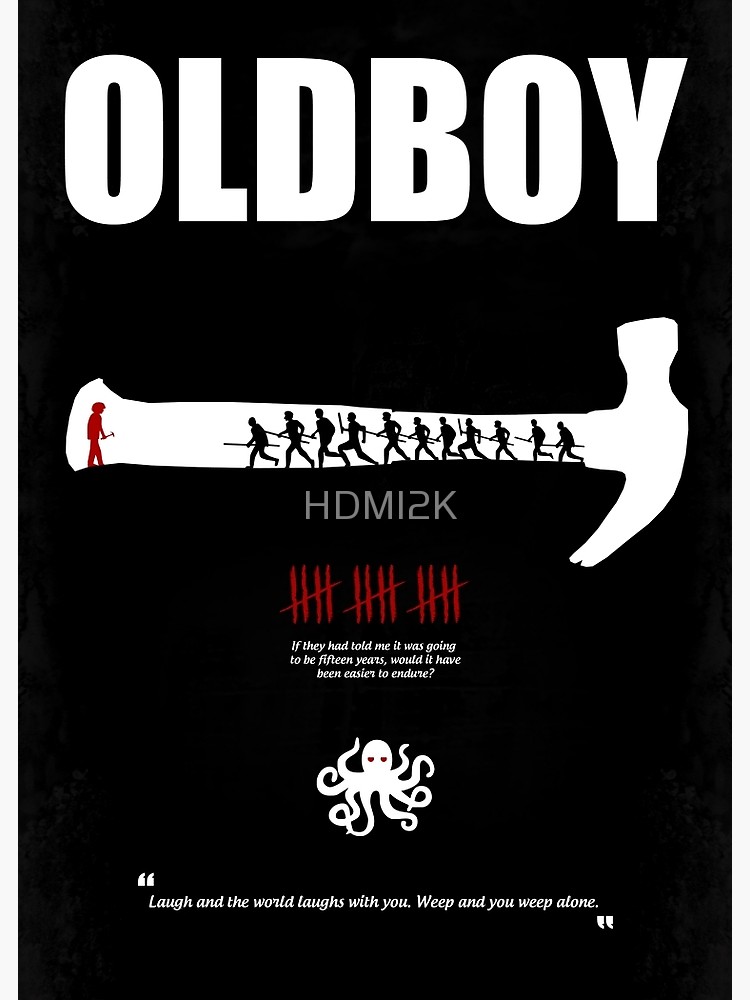
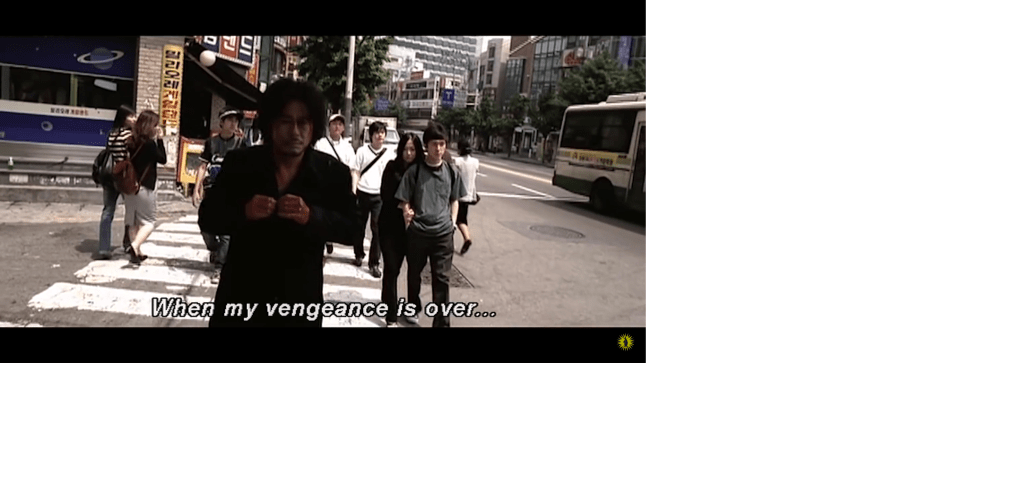
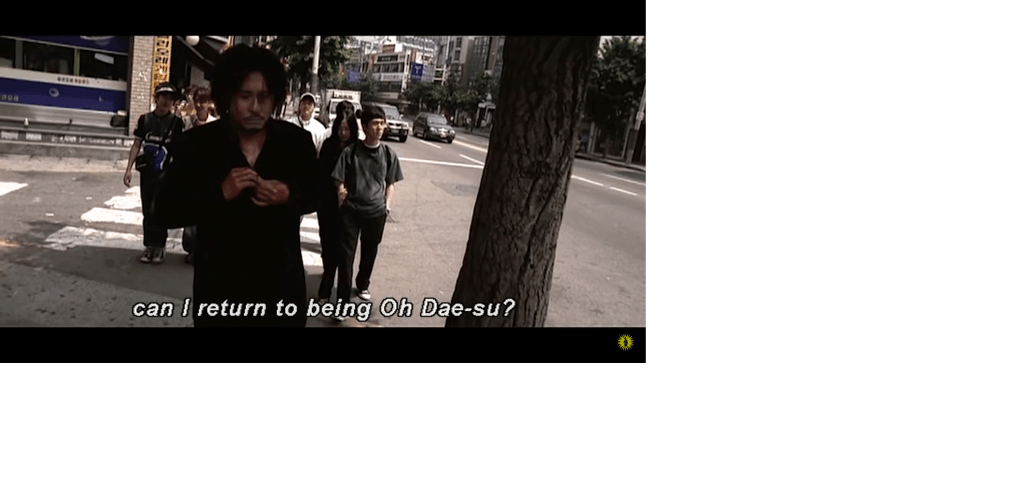
A film that represents this idea near perfectly is Oldboy (2003, Chan-wook). Following a single man’s journey of revenge after being kidnapped and held captive for 15 years in a highly controlled environment, in an effort to find a seemingly omnipresent and all-knowing villain, the film’s narrative explores and challenges the Colonial Period of Korea with its thematic throughlines and parallels to the feelings of that time period.

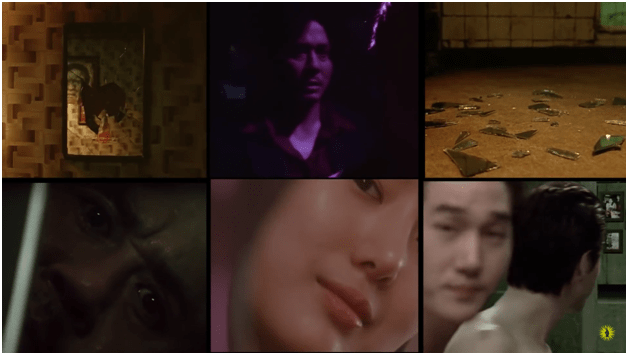
Mirrors and reflection play an important role in Oldboy.

A prominent example of this is the repeated use of mirrors, and mirror substitutes, throughout the narrative. The use of mirrors and reflections indicate a fragmentation of oneself, and in the case of Oldboy, Oh Dae-su. The character of Dae-su is a representation of the Korean people, being kidnapped, utterly controlled in a limited environment and, once freed, has an incredibly hard time adjusting and is much too haunted by his past, even differentiating himself from the ‘old’ Dae-su and the ‘new’ one. In one scene, as he is hunting down Woo-jin, he even asks himself if he can return to the original Oh Dae-su. In this regard, the film explores the feelings of the Korean people as they entered into the new millennium. After the occupation by Japan and the subsequent Korean War which split the country into two very different sides, the feeling of aimlessness and division was extremely powerful in the Korean zeitgeist. This is further hammered home by the differences between Dae-su and Woo-jin. While Woo-jin, representative of the Japanese businessmen who controlled Korea during the occupation, uses money and psychology for control, Dae-su (the proletariat) makes use of a hammer, a working man’s tool.

Woo-jin’s death is also symbolic of the crippling of Japan, being demoted from this unstoppable mastermind to a pathetic and mortal man that dies unceremoniously, similar to how the Japanese held seemingly unlimited power and influence before being defeated relatively easily, with their military and economy being on the verge of ruin.

Korean cinema is extreme, transgressive and unafraid to explore the difficult issues and nuances of its past, using it as a wellspring of ideas and themes to explore and dissect in all their violent and dark ways. This interest, almost need, to do so reveals a culture that is almost looking for something that they once lost, and that their identity is as closely tied to their periods of unrest as it was during peacetime, and this hardened culture are capable of exploring the most boundary pushing cinema in the world.

Works Cited:

Min, Eungjun; Joo, Jinsook; Ju Kwan, Han, Korean Film: History, Resistance, and Democratic Imagination (Praeger, 2003) p.8/9

Paquet, D. (2009). New Korean Cinema: Breaking the Waves. London: Wallflower Press, p3.

Design a site like this with WordPress.com
Get started